

As reported by Statista (2024), the size of the Kenyan footwear market is over USD 420 million and growing at almost 5 percent each year. From Kamukunji Market in Nairobi to shops in Mombasa and Kisumu, the shoe retail business is one of the avenues growing the fastest in the country.
But here’s the question every trader asks:
Are wholesale shoe suppliers in Kenya a hidden profit opportunity—or a risky investment?
After working in the shoe trade for more than a decade, I’ve seen both sides. Some retailers make excellent profits through reliable suppliers, while others lose money to fake products, poor stock choices, or slow sales.
Let’s uncover how Kenya’s wholesale shoe network really works, what profits are hidden inside it, and how to stay safe from risk.
1. How Kenya’s Wholesale Shoe Market Works
1.1 Imports vs Local Production
Most shoes in Kenya are imported.
Based on data from UN Comtrade (2024), approximately 75% of footwear is manufactured in India, China, and Turkey, with the remaining 25% being produced locally in various factories throughout Thika, Athi River, and Nairobi Industrial Area.
Nowadays, wholesaler shoe suppliers directly link and connect these manufacturers to local retail outlets. They handle bulk ordering, storage, and everyday supplies.
The best suppliers keep direct factory relationships, ensuring consistent quality and better prices.
Note: Always make sure to work with a supplier who can provide proof about where they manufacture their shoes.
1.2 Import & Shipping
Goods into Kenya come primarily through the Mombasa Port and Jomo Kenyatta International Airport. For those vendors seeking freight consolidation (combining smaller orders into freight to ship as a single shipment) may see savings of up to 20% of freight costs (Kenya Ports Authority, 2023).
Tip: Work with logistics partners that are familiar with EAC and COMESA trade law to help further reduce duties and paperwork.
2. The Profit Potential: Where the Hidden Profits Really Are
2.1 Visible Profits (Regular Margins)
In Kenya, most wholesalers earn between 25% and 40%, while retailers can make up to 60–70% depending on shoe type.
| Shoe Type | Wholesale Price (KES) | Retail Price (KES) | Profit Margin |
| PU Slippers | 350–500 | 600–900 | 45–60% |
| Men’s Sneakers | 900–1,200 | 1,500–2,000 | 40–55% |
| Women’s Sandals | 500–700 | 900–1,200 | 35–50% |
Example:
Buying 200 pairs at KES 400 and selling at KES 750** can generate KES 70,000–100,000 profit per sales cycle.
2.2 Hidden Profits Most Traders Miss
The real advantage of working with wholesale shoe suppliers goes beyond simple margins.
Here are the hidden profit areas smart traders focus on:
- Bulk Discounts & Factory Rates
Buying directly from factories through trusted suppliers gives you access to tiered pricing. Saving even KES 30 per pair on 1,000 pairs equals KES 30,000 extra profit.
- Reduced Return Rates
High-quality imports lead to fewer product returns. According to KEBS (2023), shops that sell certified products face 25% fewer customer complaints, which directly protects profit.
- Faster Turnover
Reliable suppliers deliver fresh designs regularly. Quick-moving stock means faster cash cycles and better liquidity.
- Brand Reputation
Selling durable, stylish shoes creates repeat buyers. Retailers in Nairobi CBD who maintain consistent quality report repeat customer growth of 40% per year.
- Digital Resale Profits
Many wholesalers now share catalogs that traders can post online. Selling through WhatsApp Groups or Instagram Shops helps retailers earn an extra 10–15% margin without renting a stall.
In short: The real money is not just in buying cheap—it’s in buying smart, reducing waste, and turning customers into repeat buyers.
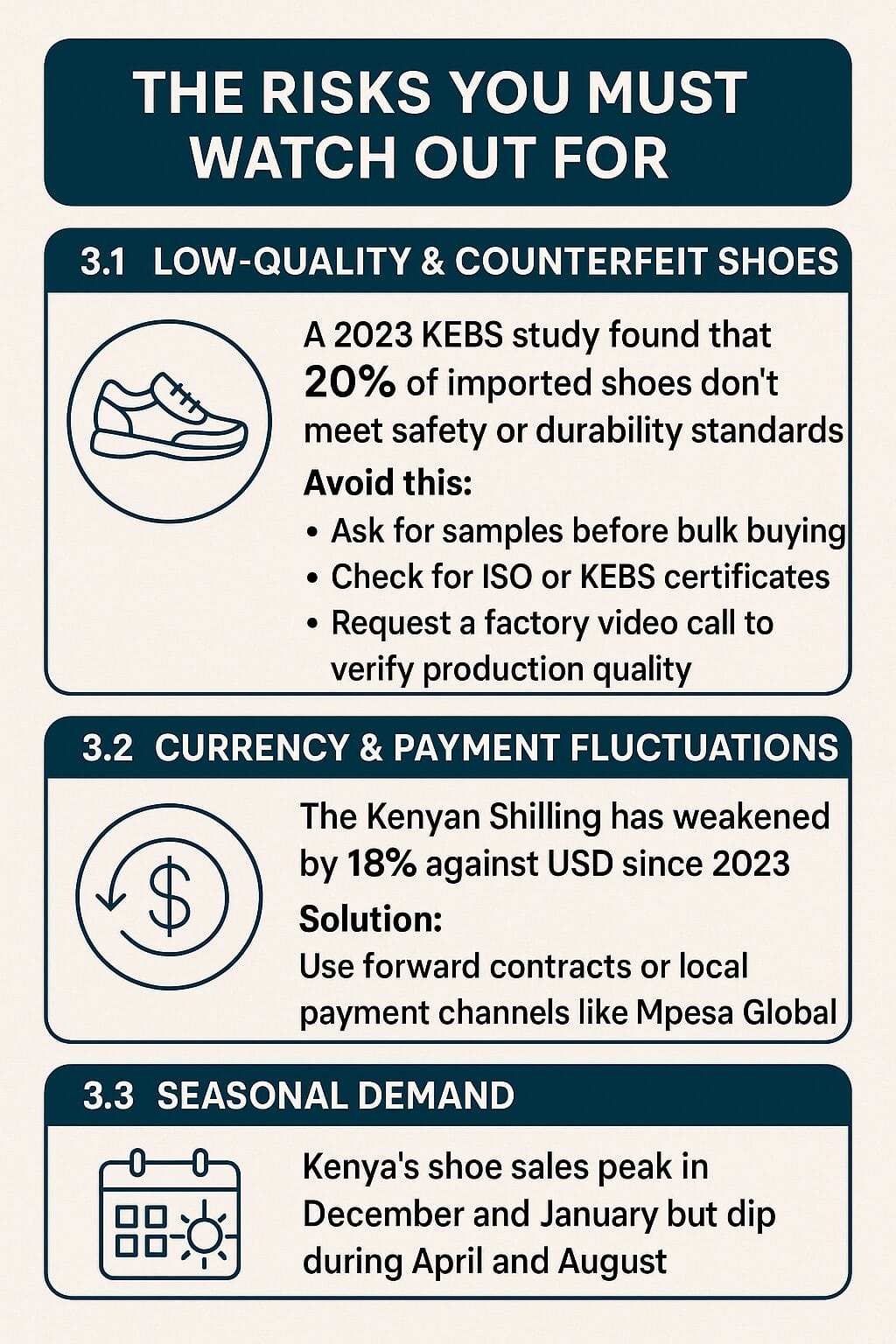
3. The Risks You Must Watch Out For
3.1 Low-Quality & Counterfeit Shoes
A 2023 KEBS study found that 20% of imported shoes don’t meet safety or durability standards.
Poor-quality imports lead to refunds, loss of reputation, and reduced profit.
Avoid this:
- Ask for samples before bulk buying.
- Check for ISO or KEBS certificates.
- Request a factory video call to verify production quality.
3.2 Currency & Payment Fluctuations
The Kenyan Shilling has weakened by 18% against USD since 2023 (Central Bank of Kenya, 2025).
Currency shifts can raise your import cost overnight.
Solution: Use forward contracts or local payment channels like Mpesa Global.
3.3 Seasonal Demand
Kenya’s shoe sales peak in December and January due to Ramadan and Christmas but dip during April and August. Overstocking during slow months locks up cash.
Tip: Keep a balanced mix—school, casual, and formal shoes—to ensure steady sales.
4. How to Identify Reliable Wholesale Shoe Suppliers
4.1 Check Supplier Background
- Verify KRA/eCitizen registration
- Review import history via Kentrade Portal
4.2 Warning Signs
- Prices far below market average
- No company bank account
- Unbranded packaging
- Missing shipping paperwork
4.3 Trade Fairs & Online Platforms
Trade fairs like the Kenya International Trade Expo and East Africa Footwear Forum are excellent for meeting verified suppliers.
Online platforms such as Alibaba and AfricaTradeLink provide verified profiles and some buyer protection as well.
5. Practical Tips for Retailers & Importers
| Area | What to Do | Benefit |
| Supplier Deals | Begin with 100–200 pairs | Reduce risk |
| Stock Updates | Change designs every 45 days | Attract buyers |
| Quality | Use PU soles & strong stitching | Fewer returns |
| Pricing | Offer budget, midrange, premium tiers | Wider reach |
| Payment | Use escrow or verified trade sites | Avoid fraud |
Conclusion:
Kenya’s shoe market offers both great profits and serious risks.
You can earn well if you choose reliable suppliers, maintain quality, and plan your inventory carefully.
The hidden profits come from buying smart, managing stock efficiently, and building customer trust—not just finding the cheapest deal.
If you want to grow with reliable sourcing, honest pricing, and African-style designs, start your journey today — powered by Picaaso Footwear.


Dev Sharma is an Industrial Content Writer and Emerging Market Analyst with 3+ years of experience studying global footwear manufacturing, wholesale supply chains, and international buyer behaviour. He specializes in creating well-researched, insight-driven content that helps traders and wholesalers understand market demand across Africa, Asia, and the Middle East. Dev focuses on breaking down complex industry patterns into practical guidance supported by data, case observations, and real-world sourcing insights. Known for his analytical writing style, he consistently explores export trends, price shifts, and evolving consumer preferences. His work serves as a trusted resource for businesses seeking clarity and expert direction in the global footwear market.



