
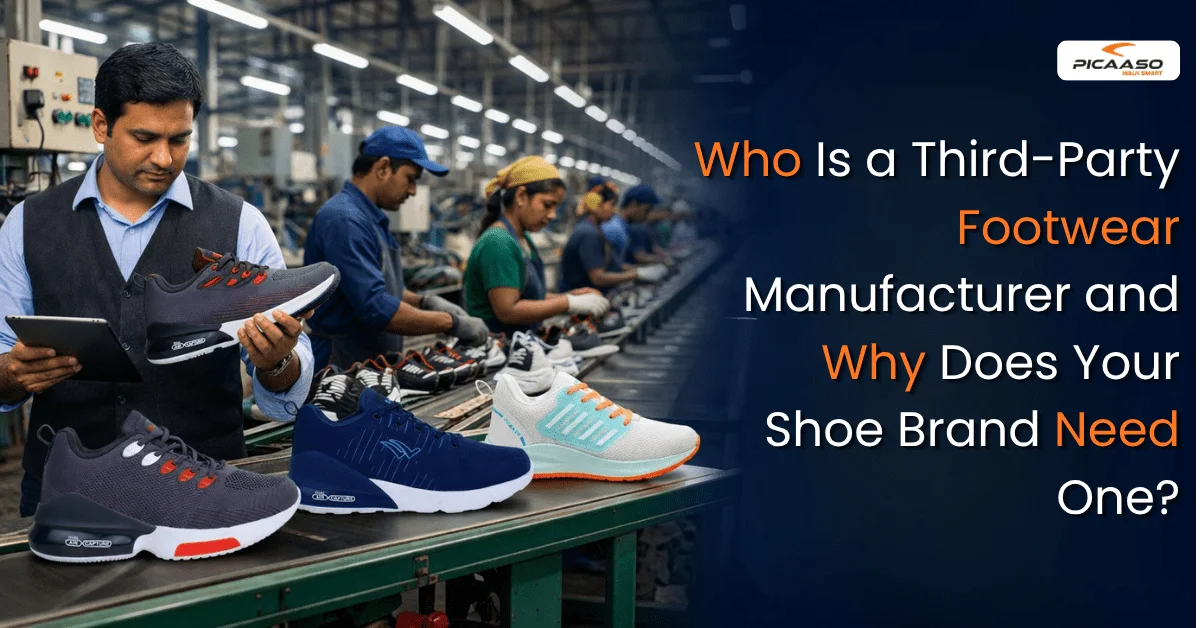
The worldwide footwear industry is expected to hit $530.3 billion in 2027 with more than half of the growth coming from lesser-known shoe brands outsourcing production smartly.
Here’s the problem facing most new brands: They have a great design idea, know who their customers are, and see that there is a real demand but don’t have a factory, the right machines, or a production team. That’s exactly why an outsourced footwear manufacturer becomes a must.
This article will explain what a third-party footwear manufacturer is; it will detail the process and feature a discussion of the services offered and how to select the right one for your brand.
Who Is a Third-Party Footwear Manufacturer?
Quick Answer
A third-party footwear manufacturer is astandalone factory that produces shoes for another brand. Youteam up with a professional without owning your own factory. Thisdelegate of material sourcing, production and deliverywill enable you to concentrate on your branding.
Simple Definition
A third-party footwear manufacturer is the one who makes the footwear on behalf of the other businesses. Those businesses own the brand. The factory stays behind the scenes to produce the physical item while the brand handles sales, marketing, and customer d ealings.
Think of it this way: Nike doesn’t own most of the factories that produce its shoes. It partners with third-party manufacturers across Vietnam, Indonesia, and China. The same model is available to brands of every size today.
How Does Third-Party Footwear Manufacturing Work?
Quick Answer
The process from design to delivery is clearly laid out in six main stages: concept, material sourcing sampling quality testing, mass production, and packaging. Quite a lot of the manufacture also takes care of all six, providing brands with a full end-to-end production solution.
Types of Third-Party Footwear Manufacturers
|
Type |
What They Do |
Best For |
|
OEM (Original Equipment Manufacturer) |
Produces shoes based on your design |
Brands with existing designs |
|
ODM (Original Design Manufacturer) |
Offers ready designs you can brand |
Startups needing quick launch |
|
Private Label |
Manufactures under your brand name |
Retailers & e-commerce sellers |
|
Contract Manufacturer |
Full production service with flexibility |
Growing brands scaling fast |
How Does Third-Party Footwear Manufacturing Work?
Quick Answer
The process from design to delivery is clearly laid out in six main stages: concept, material sourcing sampling quality testing, mass production, and packaging. Quite a lot of the manufacture also takes care of all six, providing brands with a full end-to-end production solution.
Step-by-Step Production Process
- Design & Concept Development: You give the manufacturer your design brief, sketches, or reference samples.
- Material Sourcing & Selection: Based on your specifications and budget, the manufacturer will source the materials leather fabric soles, etc. as needed.
- Sample & Prototype Creation: The manufacturer makes a sample product for you to inspect and approve before the mass production stage.
- Quality Testing & Approval: After the sample is checked for its performance, ease of use, and appearance, you either approve it or request some amendments.
- Mass Production: After your approval, the manufacturer launches the production line based on your ordered quantity.
- Packaging & Delivery: The finished shoes bearing your label are packed and dispatched to your address.
In my observation across manufacturing hubs in India and Southeast Asia, brands that invest time in the sample approval stage consistently report 30–40% fewer quality rejections during mass production.
Why Does Your Shoe Brand Need a Third-Party Footwear Manufacturer?
Quick Answer
Working with a third-party shoe maker cuts production costs, gives you expert craftsmanship, speeds product launch, lets you grow without factory headaches. You focus on brand building and sales growth instead. No need to manage facilities or labor costs. The process is simple and direct.
Key Benefits at a Glance
- Cost savings: No factory setup, no machinery investment, no permanent workforce costs
- Expert craftsmanship: Get the service of very talented shoemakers and manufacturing teams who have already been working for many years.
- Faster time-to-market: Established manufacturers can move from sample to production in as little as 30–45 days
- Easy scalability: Increase or decrease order quantities without operational risk
- Technology access: Use advanced cutting, stitching, and sole-bonding machinery without owning it
- MOQ flexibility: Many manufacturers accept orders starting from just 50–100 pairs
What Key Services Does a Third-Party Footwear Manufacturer Offer?
Quick Answer
A knowledgeable third-party shoe manufacturer can offer numerous services such as making custom shoes, private labeling, helping with design, finding materials, quality control, packaging with brand, and logistics management. No matter how big a brand is, these manufacturers can be your total shoe production partner one-stop.
Full Service Breakdown
- Custom shoe manufacturing: Build exactly the shoe you’ve designed
- Private label & white label production: Manufacture footwear bearing your brand without revealing the original manufacturer’s name.
- Design consultation: Get expert guidance on materials, construction, and trends
- Raw material sourcing: Access supplier networks for leather, textiles, rubber, and more
- Quality control & inspection: Outsourced quality control verifies that every batch remains identical.
- Branded packaging solutions: Custom boxes, tissue wrapping, hang tags aligned with your brand
- Logistics & shipping coordination: Export documentation and freight support are offered by many manufacturers.
Picaaso Footwear offers end-to-end manufacturing with flexible MOQs. It brings all services under one roof. Plus, this setup is mostly valuable for early-stage brands. It seems hard to ignore how much it simplifies scaling. The full suite of operations is available from a single source.
What Should You Look for in a Reliable Third-Party Footwear Manufacturer?
Quick Answer
Before choosing a manufacturer, verify their production experience, quality certifications, customization capabilities, MOQ terms, communication process, and delivery record. These six factors separate reliable long-term partners from low-cost suppliers that create expensive problems.
Your Evaluation Checklist
Years of experience in footwear production (look for 5+ years minimum)
- Material quality standards: Ask for material data sheets and sample swatches
- Certifications: ISO certification, ethical manufacturing compliance, and export licenses
- Customization range: Can they handle your specific design, sole type, and material?
- MOQ flexibility: Do their minimums fit your current order volume?
- Communication responsiveness: How quickly do they respond and how transparent are they?
- Delivery reliability: Ask for references or production history before committing
Common Mistakes Brands Make When Choosing a Manufacturer
Quick Answer
The biggest mistakes include skipping sample evaluation, ignoring certifications, choosing purely on price, and proceeding without a written contract. Each of these shortcut decisions can result in rejected inventory, delayed launches, or financial loss.
- Skipping sample testing before approving mass production
- Not requesting certifications or verifying credentials
- Choosing the lowest price without assessing quality standards
- Using vague verbal agreements instead of written contracts
- Poor communication and unclear technical specifications
- Ignoring MOQ terms until they cause cash flow problems
What surprised me during several sourcing evaluations was how many startup brands skip the sample stage to save time, only to face full-batch rejections later that cost 3–5x more than a sample approval would have.
How Picaaso Is a Trusted Third-Party Footwear Manufacturer
Quick Answer
Picaaso is a trusted third-party footwear manufacturer known for its premium craftsmanship, wide range of footwear categories, flexible MOQ, end-to-end manufacturing support, and strong commitment to quality, making it the ideal manufacturing partner for both startups and established shoe brands.
Picaaso Footwear brings together years of production expertise, a comprehensive range of footwear categories, and a customer-first approach that makes it stand out in a competitive manufacturing landscape.
What makes Picaaso different is its ability to serve brands at every stage, from a first-time entrepreneur launching a 500-pair collection to an established retail brand scaling to tens of thousands of units. Their flexible MOQ, quality-first production process, and dedicated account support make them a reliable long-term partner.
Picaaso manufacturing process follows strict quality checkpoints at every stage from raw material inspection to final packaging review, ensuring that every pair meets the brand’s exact specifications before shipment.
Who Should Work with a Third-Party Footwear Manufacturer?
Quick Answer
Any individual or business that wants to sell shoes without owning a factory should consider a third-party manufacturer, including startups, fashion designers, e-commerce sellers, retailers expanding their product range, and entrepreneurs building a private label shoe brand.
Ideal Business Profiles
- Startup shoe brands: Limited capital but a clear product vision
- Fashion designers: Entering the footwear market for the first time
- E-commerce businesses: Needing reliable inventory at scale
- Retail brands: Adding footwear to their existing product line
- Private label entrepreneurs: Building their own branded shoe range
Conclusion
Working with a third-party footwear manufacturer isn’t just a cost-saving decision; it’s a strategic one. Here are the key takeaways from this guide:
- Third-party manufacturers handle everything from materials to delivery, so you don’t need to build or run a factory.
- Outsourcing production cuts costs by 25–35% compared to in-house manufacturing for most early-stage brands.
- OEM, ODM, and private label models give brands flexibility depending on their design capability and budget.
- Choosing the right manufacturer requires verifying experience, certifications, MOQ flexibility, and communication standards, not just price.
- E-commerce and startup brands stand to gain the most from third-party manufacturing partnerships in 2026’s competitive market.
If you have the intention of starting or growing your shoe brand, the correct manufacturing partner is going to be your number one crucial step. Contact Picaaso Footwear now to talk about your needs, ask for a sample, or find out what can be done for your brand.

Dev Sharma is an Industrial Content Writer and Emerging Market Analyst with 3+ years of experience studying global footwear manufacturing, wholesale supply chains, and international buyer behaviour. He specializes in creating well-researched, insight-driven content that helps traders and wholesalers understand market demand across Africa, Asia, and the Middle East. Dev focuses on breaking down complex industry patterns into practical guidance supported by data, case observations, and real-world sourcing insights. Known for his analytical writing style, he consistently explores export trends, price shifts, and evolving consumer preferences. His work serves as a trusted resource for businesses seeking clarity and expert direction in the global footwear market.

Dev Sharma is an Industrial Content Writer and Emerging Market Analyst with 3+ years of experience studying global footwear manufacturing, wholesale supply chains, and international buyer behaviour. He specializes in creating well-researched, insight-driven content that helps traders and wholesalers understand market demand across Africa, Asia, and the Middle East. Dev focuses on breaking down complex industry patterns into practical guidance supported by data, case observations, and real-world sourcing insights. Known for his analytical writing style, he consistently explores export trends, price shifts, and evolving consumer preferences. His work serves as a trusted resource for businesses seeking clarity and expert direction in the global footwear market.



