
India’s school shoe market hits 8,500 crore and grows at 7.2% yearly through 2027, per IFLDP. That number includes 450 million kids in public schools wearing shoes daily. Demand spikes after monsoon season when puddles appear on pavements. Many parents now choose breathable fabrics like cotton blend to keep children dry and comfortable during walks home.
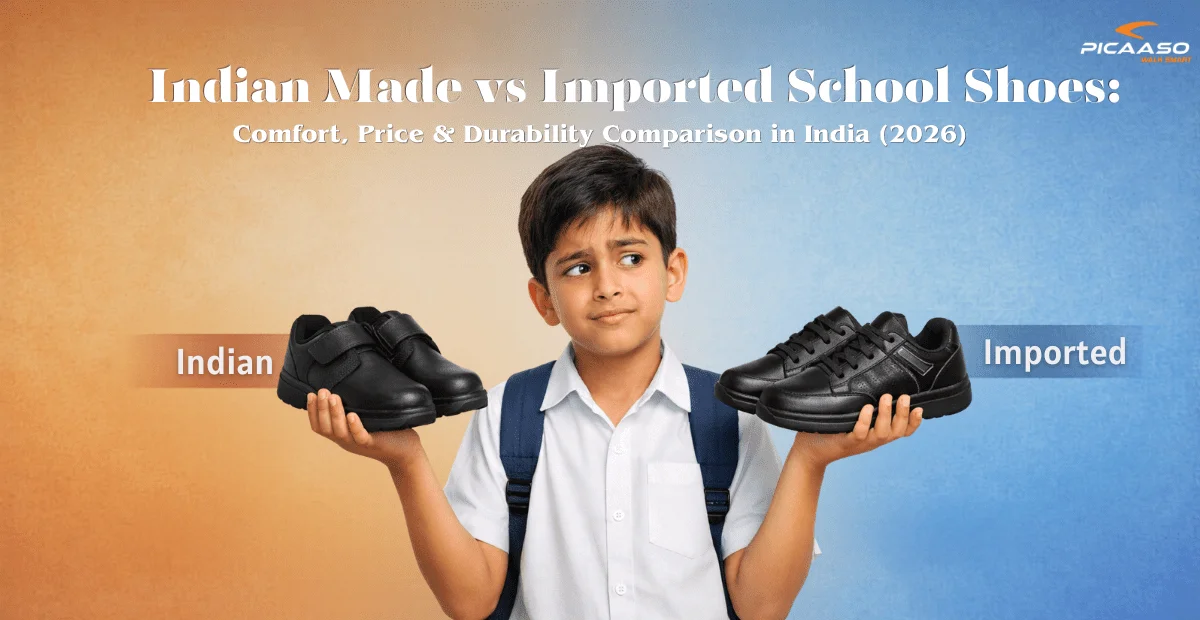
Every year, over 280 million school-going children need at least one pair of school shoes and parents face a recurring question: should you buy Indian-made or imported school shoes?
This blog breaks down the Indian made vs imported school shoes debate across three critical factors: comfort, price, and durability, so you can make a smart, informed decision.
Tracking domestic shoe buying patterns across tier-1 and tier-2 Indian cities, I’ve noticed a clear shift: parents who once leaned toward imported labels for their perceived quality are now returning to Indian-made brands and the data supports why.
What Are Indian Made School Shoes And Who Makes Them?
Indian-made school shoes are manufactured domestically, using locally sourced or imported raw materials, and are designed to meet Indian school standards, foot shapes, and climate conditions. They range from budget leather variants to ISI-certified formal school shoes.
India has a well-established footwear manufacturing base. Cities like Agra, Chennai, Kanpur, and Kolkata are home to thousands of small, mid-size, and large-scale footwear manufacturers. India is the second-largest footwear producer in the world, producing around 2.2 billion pairs annually, as per the Council for Leather Exports (CLE).
Common materials used include:
- Full-grain and synthetic leather for upper construction
- PVC and rubber for outsoles
- Canvas and mesh for breathability layers
- EVA foam for midsole cushioning
Indian Footwear manufacturer sell through school uniform stores, local retail chains, e-commerce platforms like Flipkart and Amazon India, and direct B2B school supply contracts.
What Are Imported School Shoes And Where Do They Come From?
Imported school shoes are primarily manufactured in China, Vietnam, and Indonesia, then shipped to India through direct import or third-party distributors. They vary significantly in quality, material standards, and fit consistency.
Many imported school shoes entering the Indian market are mass-produced synthetic products with little adaptation to Indian foot geometry or climate conditions.
Typical materials used in imported school shoes include:
- Synthetic PU leather (low breathability)
- Injection-moulded rubber soles (varying quality)
- Textile and bonded leather composites
In India, imported school shoes are sold primarily through:
- Multi-brand online retail platforms
- Urban lifestyle stores
- Grey market distributors in major metros
Price range: ₹800 to ₹3,000+ per pair, depending on brand and import source.
Head-to-Head Comparison: Indian Made vs Imported School Shoes
Feature | Indian Made | Imported |
Comfort Fit | Designed for Indian foot width & shape | Generic fit; may not suit Indian feet |
Price Range | ₹300 – ₹1,200 | ₹800 – ₹3,000+ |
Durability | 8–12 months (quality brands) | Varies widely; often 3–6 months |
Material Standards | ISI-certified options available | Often unverified standards |
Climate Suitability | Built for Indian heat, humidity & monsoon | May crack, peel, or degrade faster |
Availability | Pan-India — online + offline | Mostly urban & online only |
After-Sales Support | Easy local returns & support | Difficult; no local service |
Sole Construction | Stitched + bonded options | Mostly bonded only |
Make in India Benefit | Supports domestic industry | Import-dependent |
How Do Indian Made and Imported School Shoes Compare on Comfort?
Indian-made school shoes are built around the Indian foot profile, wider forefoot, flatter arch making them a more comfortable fit for most school children spending 6–8 hours on their feet daily. Imported shoes often use European or Chinese foot lasts that don’t align with Indian anatomy.
Why Indian feet need Indian shoes
The average Indian child’s foot tends to be wider at the toe box compared to East Asian or European averages. Imported shoes manufactured on standard Chinese lasts often feel tight, restrict natural toe splay, and cause long-term discomfort with daily wear.
Key comfort features to look for in school shoes:
- Padded collar and tongue: reduces ankle friction
- Arch support insole: prevents flat foot development
- Wide toe box: allows natural toe movement
- Breathable upper material: essential for Indian summers and monsoon
- Shock-absorbing outsole: protects growing joints during play
Indian climate demands local design
India’s climate presents a unique challenge: intense heat from March to June, followed by monsoon humidity from July to September. Shoes made for European or East Asian climates often use synthetic materials that trap heat and moisture, a recipe for discomfort and fungal issues in Indian school conditions.
Indian manufacturers use breathable textile linings, moisture-wicking insoles, and rubber compounds formulated for grip on wet surfaces: design choices made for real Indian school conditions, not generic global markets.
How Do Indian Made vs Imported School Shoes Compare on Price?
Indian-made school shoes offer significantly better value for money, with quality options available between ₹300 and ₹1,200. Imported shoes start at ₹800 and can exceed ₹3,000 without necessarily offering better durability or comfort for Indian conditions.
The real cost of imported school shoes
The visible price tag isn’t the full story. Imported shoes often carry hidden costs:
- Import duties of 25–35% embedded in retail pricing
- No warranty or return policy for defective pairs
- Replacement frequency, lower-quality imports may last only 3–6 months
For India’s large middle-class family segment where school footwear is a recurring annual expense this matters. According to the National Sample Survey (NSS), Indian households spend an average of ₹1,100–₹1,800 per child per year on school footwear.
Value for Indian families
Indian-made school shoes from quality manufacturers offer:
- Stitched construction that lasts longer than glued soles
- Genuine leather and ISI-certified synthetic options at ₹500–₹900
- Wide availability in sizes for toddlers through teens
- Local retailer warranty and easy replacement
In practice, a ₹700 pair of Indian-made shoes from a quality manufacturer often outlasts a ₹1,500 imported pair because the Indian product is built for Indian use patterns.
How Do Indian Made vs Imported School Shoes Compare on Durability?
Quality Indian-made school shoes, especially from established manufacturers, consistently outperform most imported alternatives in real-world durability particularly under the wear conditions typical of Indian school environments.
What makes school shoes durable?
School shoes face a daily beating playground gravel, wet monsoon floors, staircases, and PE sessions. Durability depends on three core construction factors:
- Sole bonding method: Stitched soles are far more durable than purely glued soles. Many quality Indian manufacturers use Goodyear welt or direct stitch construction.
- Upper material quality: Full-grain leather and high-density synthetic leather resist cracking and peeling under repeated flexing.
- Toe cap reinforcement: Reinforced rubber or leather toe caps prevent the most common failure point in school shoes.
Where imported shoes often fall short
Many imported school shoes particularly at the ₹800–₹1,500 price point, use bonded leather uppers and cold-glued soles. In India’s heat, adhesive bonds soften and delaminate faster. This pattern appears consistently in buyer reviews across major Indian e-commerce platforms.
Data appears to indicate that outsole delamination is the top complaint for imported school shoes under ₹1,500 a structural failure point that quality Indian manufacturers have addressed through improved vulcanised rubber bonding and heat-resistant adhesives.
Picaaso Footwear: India’s Best School Shoe Manufacturer
Picaaso Footwear stands out as one of India’s most trusted school shoe manufacturer producing purpose-built school footwear that combines quality materials, Indian foot-specific design, and accessible pricing.
Through my observation of the domestic school footwear segment, brands that consistently receive repeat institutional orders share a common profile: they understand the Indian school environment deeply. Picaaso Footwear is a strong example of this, its product range is designed from the ground up for Indian school children, not adapted from a generic export template.
What makes Picaaso Footwear a preferred choice:
- Premium materials: quality leather and certified synthetic uppers built to last the full school year
- Indian foot geometry design: wider toe box, correct arch support for Indian children’s feet
- All-day school comfort: padded insoles and breathable linings for 6–8 hours of wear
- Monsoon-ready construction: water-resistant uppers and non-slip rubber outsoles
- Full range: sizes and styles for boys and girls across all school age groups
- Affordable pricing: high quality without the premium import markup
Choosing: Picaaso Footwear also means supporting India’s Make in India initiative contributing to domestic manufacturing employment and reducing import dependency in the school footwear segment.
Which One Should You Choose Indian Made or Imported School Shoes?
For the vast majority of Indian families, Indian-made school shoes offer better value, superior comfort, and stronger durability under real school conditions. Imported shoes may suit specific use cases but rarely justify the higher cost for everyday school wear.
Choose Indian-made school shoes if you:
- Want comfortable, well-fitting shoes for Indian children’s feet
- Are budget-conscious and need value that lasts the full school year
- Live in a city where monsoon and heat are regular challenges
- Want easy after-sales support and local warranty
- Want to support domestic manufacturing
Choose imported school shoes if you:
- Have a specific brand preference for a premium lifestyle pair
- Are buying supplementary shoes beyond the primary school pair
- Are willing to accept higher cost and limited local support
Verdict: For daily school use in India, Indian-made wins on every practical metric.
What Are the Key Buying Tips for School Shoes in India?
Buying the right school shoe involves checking construction quality, material certifications, and sizing not just price. These practical tips apply whether you’re buying Indian-made or imported.
- Check sole construction first: Prefer stitched or stitched-and-bonded soles over cold-glued soles
- Look for the ISI mark: IS 5557 is the Bureau of Indian Standards certification for school shoes; it’s a reliable quality indicator
- Buy half a size up: Children’s feet grow rapidly; a small allowance prevents discomfort within months
- Test breathability: Press the upper, it should flex easily and not feel stiff or plasticky
- Check the toe cap: Reinforce rubber toe caps are a must for school use
- Buy before peak season: Stock quality and variety is best between February and May, before the June school rush
- Trust Indian manufacturers: Established domestic brands like Picaaso Footwear are built for Indian school conditions
Conclusion
This comparison makes it easy to see what really matters. Indian shoes win on comfort, price, and how well they handle heat, perfect for daily wear in schools. Price stability and fit are strong points (In particular in monsoon seasons).
Key takeaways from this comparison:
- Indian-made shoes are designed for Indian foot shapes better comfort from day one
- Pricing is 40–60% more affordable than comparable imported options
- Durability is stronger due to stitched construction and Indian-climate-tested materials
- After-sales support is far easier with domestic brands
- Choosing Indian-made supports the domestic manufacturing sector
Picaaso Footwear, one of India’s leading school shoe manufacturer exemplifies what a purpose-built Indian school shoe looks like: quality materials, correct fit, and pricing that works for Indian families.

Dev Sharma is an Industrial Content Writer and Emerging Market Analyst with 3+ years of experience studying global footwear manufacturing, wholesale supply chains, and international buyer behaviour. He specializes in creating well-researched, insight-driven content that helps traders and wholesalers understand market demand across Africa, Asia, and the Middle East. Dev focuses on breaking down complex industry patterns into practical guidance supported by data, case observations, and real-world sourcing insights. Known for his analytical writing style, he consistently explores export trends, price shifts, and evolving consumer preferences. His work serves as a trusted resource for businesses seeking clarity and expert direction in the global footwear market.

Dev Sharma is an Industrial Content Writer and Emerging Market Analyst with 3+ years of experience studying global footwear manufacturing, wholesale supply chains, and international buyer behaviour. He specializes in creating well-researched, insight-driven content that helps traders and wholesalers understand market demand across Africa, Asia, and the Middle East. Dev focuses on breaking down complex industry patterns into practical guidance supported by data, case observations, and real-world sourcing insights. Known for his analytical writing style, he consistently explores export trends, price shifts, and evolving consumer preferences. His work serves as a trusted resource for businesses seeking clarity and expert direction in the global footwear market.



